
Envelope Budgeting in a Digital Age: Cash Envelopes vs. Spending Categories
In this article
Weigh the classic cash envelope method against digital spending categories to find the budgeting approach that fits your household.
Key Takeaways
- Cash envelopes create physical friction that can reduce impulse spending for some households.
- Digital spending categories work across card transactions and can sync with bank accounts automatically.
- Neither method produces results without a realistic spending plan built first.
- Hybrid approaches, using cash for high-risk categories and digital tools for fixed expenses, are common and practical.
- The method you will actually stick with consistently matters more than which one is theoretically better.
How each method works
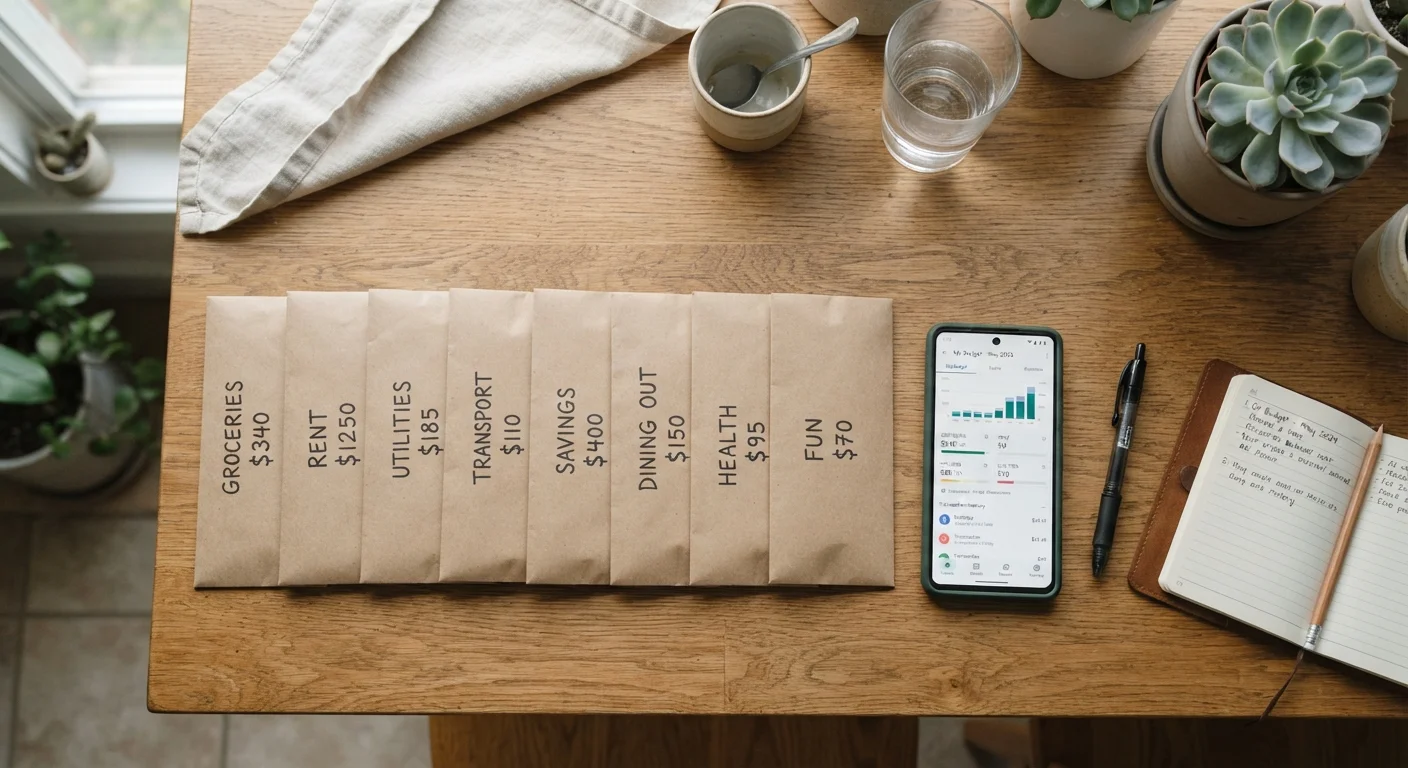
The cash envelope system is straightforward. At the start of each budget period, you withdraw cash and divide it into labeled envelopes, one per spending category. Groceries get $400, dining out gets $150, and so on. When an envelope is empty, spending in that category stops until the next period. There is no app, no account syncing, and no transaction log. The limit is physical.
Digital spending categories work on the same underlying idea but live inside a budgeting app or spreadsheet. You assign a dollar limit to each category, and as transactions come in from your bank or credit card, they get tagged to those buckets. When a category hits its limit, the app signals that you have run out of room. Some tools do this automatically through bank feeds; others require manual entry.
Both methods are built on zero-based or category-constrained budgeting, meaning every dollar of income gets assigned a purpose before it is spent. The difference is entirely in execution. For a broader look at how average U.S. households actually allocate income across categories, see where the money actually goes in our family finance series.
Side-by-side comparison
The table below covers the practical differences families typically encounter when choosing between the two approaches.
| Criterion | Cash envelopes | Digital categories |
|---|---|---|
| Works for online purchases | No | Yes |
| Setup effort | Low, requires ATM trip | Moderate, requires app setup |
| Spending friction | High (physical cash) | Low to moderate |
| Transaction record | None unless manual | Automatic or manual log |
| Adjusting limits mid-month | Move cash between envelopes | Edit a number in the app |
| Works for irregular income | Awkward, requires re-sorting | Easier to adjust |
| Risk of loss or theft | Yes (physical cash) | No (data only) |
| Good for teaching kids | Yes, concrete and visual | Less intuitive for children |
One thing the table cannot capture is behavioral fit. Some people find that seeing a shrinking pile of bills creates a genuine spending brake. Others find cash inconvenient enough that they abandon the system within a month. A method that gets dropped is no method at all.
Where each method tends to break down
Cash envelopes run into trouble in a few common situations. Online purchases, recurring subscriptions, and bill autopay cannot draw from a physical envelope. Carrying large amounts of cash raises safety concerns, and losing an envelope is a real risk. Some families also find the monthly trip to the ATM and the act of sorting bills more effort than it is worth.
Digital categories have their own failure points. The main one is the gap between logging and feeling. Seeing a number change on a screen does not carry the same psychological weight as handing over a $20 bill. Auto-categorization in apps is often imprecise, and correcting mislabeled transactions takes discipline. Without a weekly check-in habit, the categories can drift. Spending traps hidden inside everyday shopping routines covers how subscription creep and similar habits quietly inflate spending even when a budget is nominally in place.
Hybrid approaches worth considering
Many households find that combining both methods reduces the weaknesses of each. A common pattern is to use cash envelopes for two or three high-risk discretionary categories, such as groceries, restaurants, and personal spending money, while tracking fixed and online expenses digitally. This limits how much cash you need to carry while preserving the behavioral friction where it matters most.
If your household is working from a monthly budget for the first time, building a monthly family budget from scratch walks through how to set realistic category limits before you decide which tracking method to use. Getting the numbers right first makes either system more effective.
For families who travel with a budget, the same category logic applies on the road. The family travel budget principles article outlines how to apply spending caps to trip costs without the complexity of carrying travel cash envelopes.
This article is for general informational purposes only and does not constitute personalized financial advice. Consult a qualified financial professional for guidance specific to your household's situation.

Author
Family Finance Basics Editorial Team
Family Finance Basics Editorial Team is the collective byline for our editorial team and contributor network. Articles published under this byline or an editorial pen name are researched, written, and reviewed according to our editorial standards for clarity, consistency, and independence before publication.
View all articles