
Dealership Service Center vs. Independent Mechanic: What Families Should Know
In this article
Both options have genuine trade-offs. Understanding the differences helps you make smarter, budget-conscious choices for routine and major repairs.
Key Takeaways
- Federal law allows you to use independent mechanics for routine maintenance without voiding your factory warranty.
- Dealership labor rates are generally higher, but they carry brand-specific tools and software that independents may lack.
- Reputable independent shops can handle most repairs competently, especially on vehicles past their warranty period.
- For complex recalls, software programming, or warranty-covered repairs, a dealership is usually the correct choice.
- Getting written estimates from both options before committing to major work is a practical way to compare real costs.
What each option actually provides
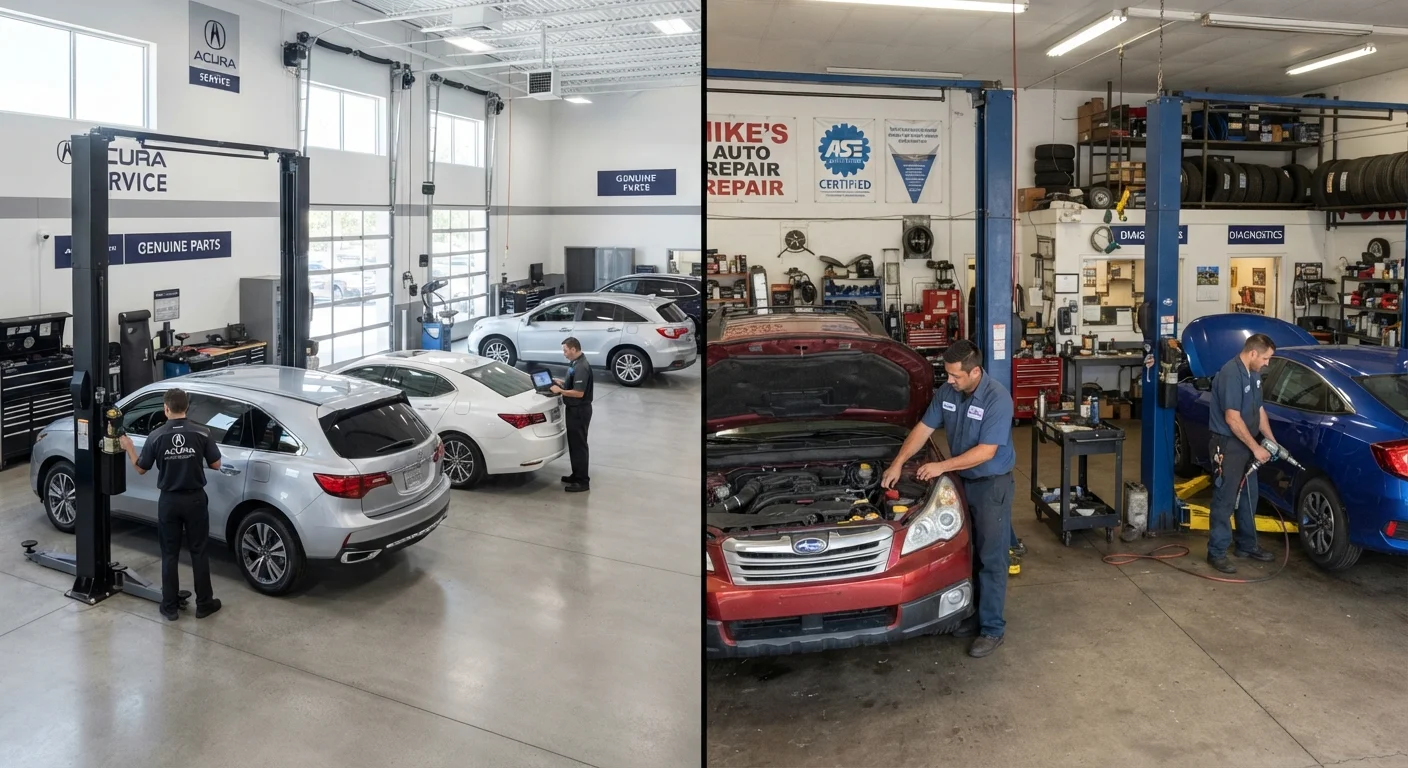
A dealership service center is staffed by technicians trained specifically on one or a few vehicle brands. They use proprietary diagnostic equipment, have direct access to manufacturer technical service bulletins, and can perform warranty repairs that the manufacturer will reimburse. That specialization has real value in specific situations.
An independent mechanic operates outside any manufacturer relationship. Many are ASE-certified (Automotive Service Excellence), which is a nationally recognized credential that tests competency across a range of repair categories. Independent shops often carry the same quality of replacement parts dealers use, since both source from many of the same suppliers. The difference is mainly in brand-specific software access and the warranty billing relationship, not necessarily in mechanical skill.
One widespread belief worth addressing: using an independent mechanic for routine maintenance does not void your factory warranty. The Magnuson-Moss Warranty Act protects consumers on this point. You can read more about that and similar misconceptions in our article on common car repair myths that lead drivers to overpay.
Cost differences and where they come from
Dealership labor rates are set partly to cover significant overhead: specialized training programs, expensive proprietary scan tools, and large physical facilities. Independent shops carry lower overhead in most cases, and that savings can show up directly in what you pay per labor hour.
Parts pricing also differs. Dealers sell OEM (original equipment manufacturer) parts, which are made to the exact specification of what came in your vehicle from the factory. Independent shops may offer OEM parts, OE-equivalent aftermarket parts, or remanufactured parts depending on the job. For most routine repairs, quality aftermarket parts perform comparably to OEM at a lower price. For powertrain components or anything covered under an active warranty claim, OEM is typically required.
| Criterion | Dealership Service Center | Independent Mechanic |
|---|---|---|
| Labor rate | Generally higher | Generally lower |
| Technician training | Brand-specific factory training | ASE certification and broad experience |
| Parts used | OEM (factory specification) | OEM, aftermarket, or remanufactured |
| Warranty repairs | Covered and reimbursed | Not eligible for warranty reimbursement |
| Recall completion | Yes, at no charge | Not available |
| Proprietary software access | Full access | Varies by shop investment |
| Best vehicle age | New to 5 years (in-warranty) | 5+ years or out of warranty |
Keeping up with scheduled maintenance at either type of shop matters more than where you go. If you want to understand the long-term cost of skipping service, our article on why skipping scheduled maintenance ends up costing more breaks down how neglect compounds into bigger bills.
When the dealership is the right call
Recalls are the clearest case. Manufacturers handle recalls at no charge to the owner, and only authorized dealerships can complete them. If your vehicle has an open recall, the dealer is your only option, and the repair costs you nothing.
Active warranty repairs are similar. If a component fails while the vehicle is under the factory warranty or an extended manufacturer warranty, taking it to a dealership preserves the warranty claim process. An independent shop completing the same repair would not be reimbursed by the manufacturer, so the cost would fall to you.
Some late-model vehicles also require software calibration after certain repairs, such as replacing a windshield on a car with camera-based driver assistance systems. Dealers have the manufacturer-approved tools for those procedures. Some independent shops invest in the necessary equipment, but not all do, so it is worth asking before you book.
When an independent mechanic makes more sense
Once your factory warranty expires, brand-specific access matters less for most repairs. Brake jobs, suspension work, cooling system service, and most engine repairs do not require proprietary tools. A competent independent mechanic can complete them reliably, often at a lower total cost.
Building a relationship with one shop also has practical value. A mechanic who knows your vehicle's history can spot patterns, flag developing issues early, and give you a more accurate picture of what maintenance is genuinely needed versus what can wait. That kind of continuity is harder to maintain at a large dealership with rotating service advisors.
For families running older or high-mileage vehicles, independent shops are especially worth considering. Our guide on keeping a high-mileage car running well without overhauling your budget covers which repairs make financial sense as mileage climbs.
Some maintenance tasks are also simple enough to handle yourself, which cuts labor costs entirely regardless of where you normally go. Tire rotations, oil changes, and other tasks you can learn to do yourself explains what is realistic for most owners to manage safely at home.

Author
Affordable Car Care Editorial Team
Affordable Car Care Editorial Team is the collective byline for our editorial team and contributor network. Articles published under this byline or an editorial pen name are researched, written, and reviewed according to our editorial standards for clarity, consistency, and independence before publication.
View all articles