
Tire Rotation, Oil Changes, and Other Maintenance Tasks You Can Learn to Do Yourself
In this article
Some routine maintenance jobs are straightforward enough for most owners to handle safely at home, saving money on labor costs over time.
Key Takeaways
- An oil change and tire rotation are among the most accessible DIY maintenance tasks for most vehicle owners.
- Using your owner manual for fluid specs and torque values prevents the most common DIY mistakes.
- Skipping proper jack stands during a tire rotation is a serious safety risk, not just a shortcut.
- Some jobs, including brake hydraulics and suspension work, should go to a qualified mechanic regardless of skill level.
- Labor savings from DIY maintenance add up meaningfully over years of vehicle ownership.
Which tasks are reasonable for most owners to attempt
Not every maintenance job requires a shop. A number of routine tasks are straightforward enough that most owners, with a little preparation and the right tools, can complete them safely in a driveway or garage. The savings on labor costs can be meaningful over time, and building familiarity with your vehicle helps you catch problems earlier.
The key is matching the task to your actual skill level and available tools, not optimism. Three jobs fit that description well for most people: oil changes, tire rotations, and a handful of checks and replacements that require nothing more than basic hand tools.
Before starting any of these, read the relevant sections of your owner manual. The manual gives you the manufacturer's fluid specs, torque values, and maintenance intervals for your specific vehicle. Ignoring it is the most common source of DIY mistakes.
Oil viscosity grade
A number like 5W-30 that describes how thick or thin motor oil is at different temperatures. Your owner manual specifies which grade your engine requires.
Jack stand
A metal support placed under a vehicle after it has been lifted with a jack. It holds the vehicle safely off the ground while you work.
Torque specification
The exact tightening force (measured in foot-pounds) that a fastener like a drain plug or lug nut should receive. Over- or under-tightening can cause damage or create safety hazards.
Drain plug
A threaded bolt at the bottom of the oil pan that you remove to drain old oil out of the engine.
Rotation pattern
The specific sequence in which tires are moved between positions (front-left, front-right, rear-left, rear-right) during a tire rotation. The correct pattern depends on the vehicle's drivetrain and whether tires are directional.
Magnuson-Moss Warranty Act
A U.S. federal law that generally prevents a manufacturer from voiding your warranty simply because you performed your own maintenance, as long as you used appropriate parts and fluids.
How to do an oil change at home
An oil change involves draining the old motor oil, replacing the oil filter, and refilling with fresh oil to the correct level. Most passenger vehicles follow the same basic procedure, though exact locations vary.
You will need a drain pan, the correct filter wrench, a ratchet with the right size socket for the drain plug, a funnel, and fresh oil and a new filter matched to your vehicle. Your owner manual specifies the oil grade (for example, 5W-30) and filter type.
Warm the engine for two or three minutes before draining, since warm oil flows out more completely. Position the drain pan under the oil pan drain plug, remove the plug carefully (hot oil will flow fast), and allow it to drain fully. Replace the drain plug and tighten it to the torque value listed in your manual. Install the new filter by hand until snug, then turn it a quarter turn more. Add the correct amount of new oil, check the dipstick, and run the engine briefly to look for leaks.
Used motor oil must be recycled properly. Most auto parts retailers accept it at no charge. Staying on schedule with oil changes is one of the most cost-effective things you can do for an engine's longevity.
Tire rotation without a lift
Tire rotation moves each tire to a different position on the vehicle so all four wear at a similar rate. Uneven wear shortens tire life and can affect handling.
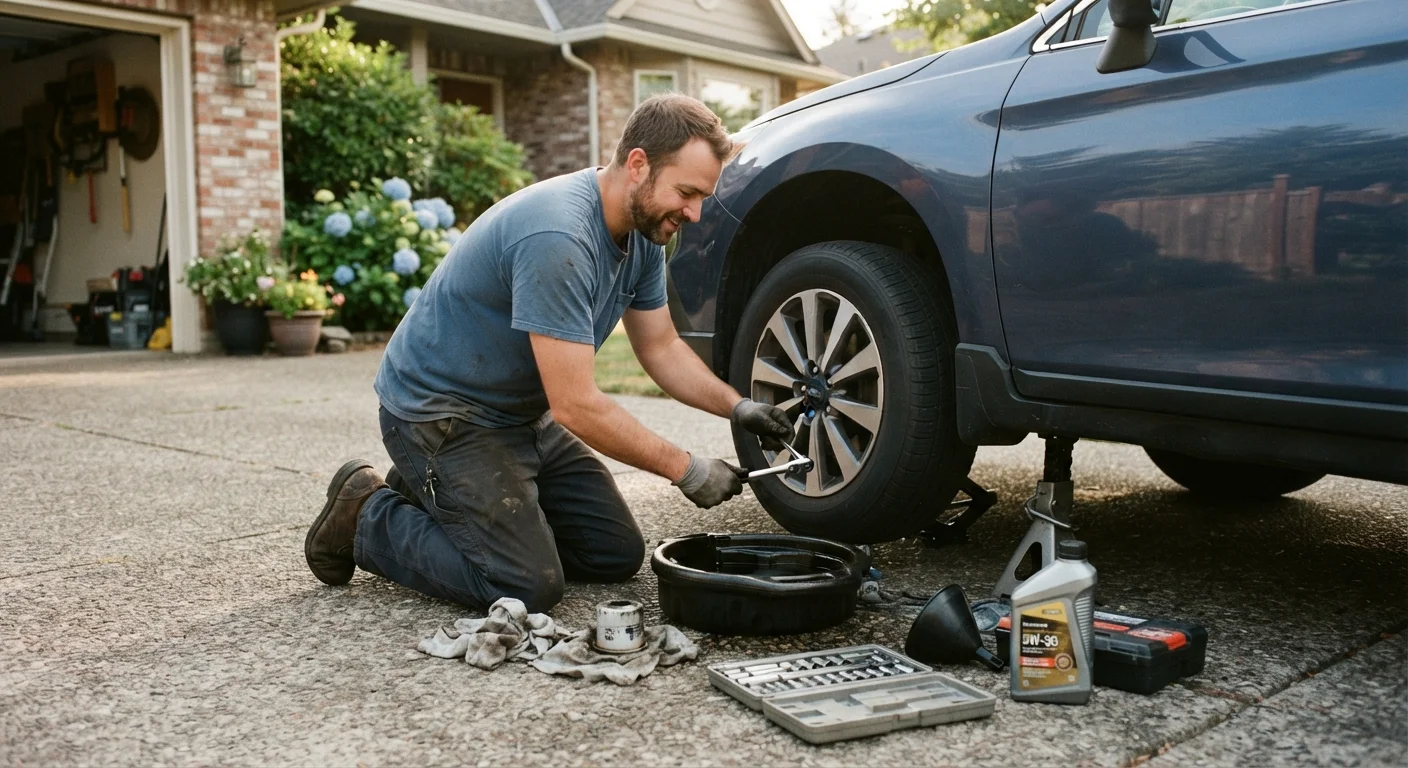
You can rotate tires at home using a quality hydraulic floor jack and two rated jack stands. A scissor jack (the one in your trunk) is for emergency roadside use only and should never support a vehicle while you work under or beside it. Work on flat, solid ground, set the parking brake, and place wheel chocks behind the tires that stay on the ground.
Check your owner manual for the correct jack points on your specific vehicle. Lift one corner at a time, place a jack stand under the rated support point, and lower the vehicle onto the stand before removing the wheel. Follow the rotation pattern your manual recommends; the pattern depends on whether your vehicle has directional tires and whether it is front-wheel, rear-wheel, or all-wheel drive.
After reinstalling each wheel, torque the lug nuts to the manufacturer's specification in a star pattern, not in a circle. Check tire pressure once all four wheels are back on the ground.
Other simple jobs worth learning
Several other maintenance tasks fall within reach for most owners and require only basic tools.
- Air filter replacement: The engine air filter is usually held in a plastic housing secured by clips or a few screws. Replacing it takes about five minutes. Check your manual for the correct interval.
- Cabin air filter replacement: This filter cleans air entering the passenger cabin. It is typically located behind the glove box or under the dashboard, and most vehicles allow access without tools.
- Windshield wiper blades: Most wiper blades attach with a simple hook-and-tab system. The packaging usually includes model-specific instructions.
- Checking and topping off fluids: Coolant, brake fluid, power steering fluid, and windshield washer fluid all have marked reservoirs under the hood. Checking levels and adding fluid (using the type specified in your manual) is low-risk and takes minutes.
Keeping filters and fluids in good condition also has a direct effect on fuel economy, so these small jobs carry more value than their simplicity suggests.
Keep a simple maintenance log
Write down the date, mileage, and what you did every time you complete a maintenance task. A basic notebook or a notes app works fine. This record helps you stay on schedule and can be useful documentation if a warranty question ever comes up.
When to stop and call a mechanic
DIY maintenance has a firm boundary. Some work carries real injury risk or requires specialized equipment and training that most owners do not have. Getting that boundary wrong can cost far more than any labor savings.
Brake hydraulic work (replacing calipers, brake lines, or master cylinders) involves pressurized fluid and directly affects stopping ability. Suspension and steering components affect vehicle control at speed. Airbag system components can deploy without warning. High-voltage systems in hybrid and electric vehicles require specialized safety equipment and training. Fuel system repairs on pressurized systems carry fire risk.
None of these are areas to learn through trial and error. If a job involves any of these systems, choosing the right shop matters more than the labor cost itself.
A useful rule: if you cannot confidently identify every step before you start, or if a mistake could leave the vehicle unsafe to drive, leave it to a qualified mechanic. Knowing which repairs are worth doing yourself versus which to outsource is part of smart ownership.
Frequently Asked Questions

Author
Affordable Car Care Editorial Team
Affordable Car Care Editorial Team is the collective byline for our editorial team and contributor network. Articles published under this byline or an editorial pen name are researched, written, and reviewed according to our editorial standards for clarity, consistency, and independence before publication.
View all articles