
Shopping Myths That Cost American Families Real Money
In this article
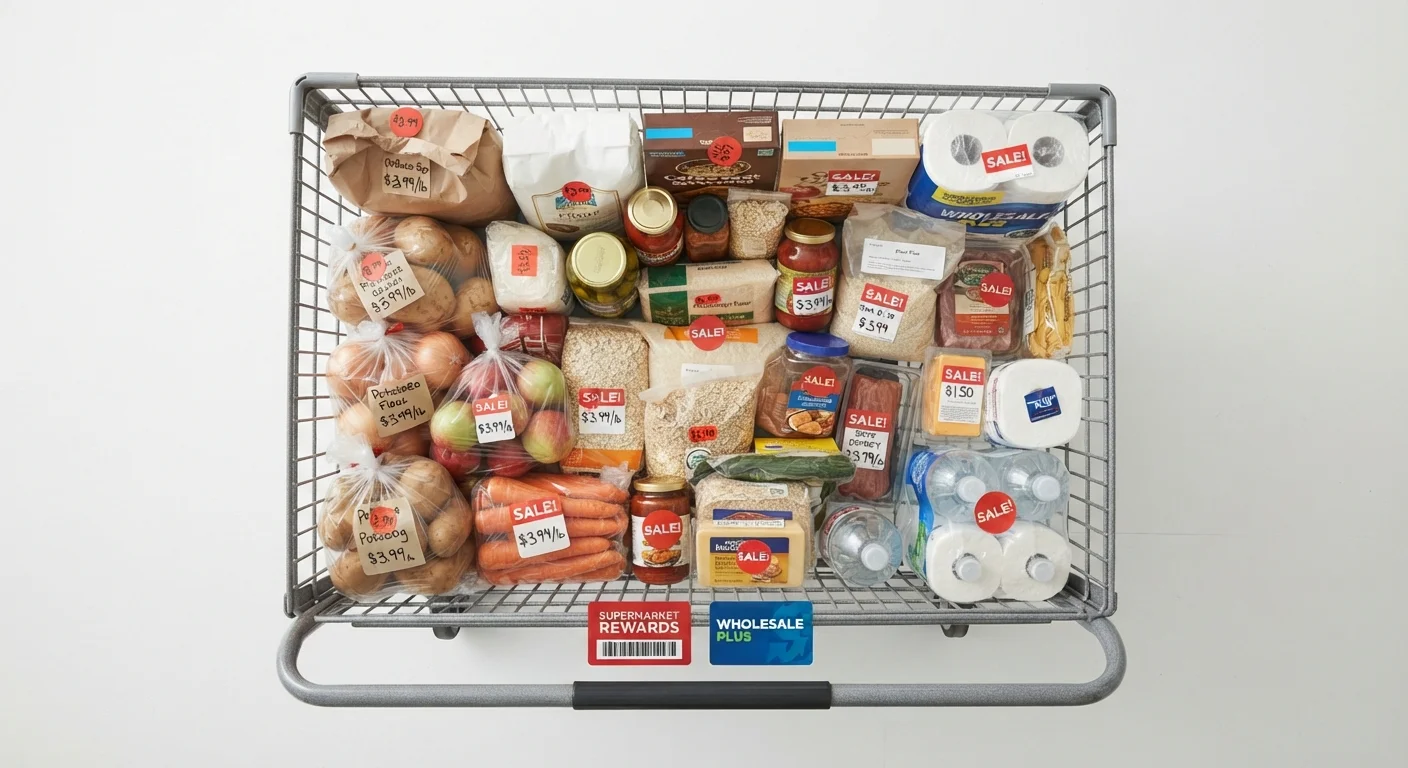
From bulk always being cheaper to loyalty programs always paying off, some widely held shopping beliefs quietly drain household budgets.
Key Takeaways
- Bulk purchases only save money when you actually use everything before it expires or goes stale.
- Sale prices are not always the lowest available price; unit pricing is a more reliable comparison tool.
- Loyalty programs can increase spending by encouraging purchases you would not otherwise make.
- Brand-name products are not consistently higher quality than their store-brand counterparts.
- Free shipping thresholds often cost more than the shipping fee they help you avoid.
- Coupon use only produces net savings when applied to items already on your shopping list.
How common shopping beliefs quietly drain budgets
Many household spending habits start as smart-sounding rules passed down through family advice or absorbed from advertising. Over time they get treated as reliable facts. The problem is that several of them consistently cost families money rather than saving it. Understanding where each belief breaks down is the first step toward shopping on actual value rather than perceived value.
Everyday spending traps often work precisely because they are wrapped in the language of savings. A "deal" framing changes behavior even when the numbers do not support it. The myths below show how that happens in practice.
Myth
Buying in bulk always saves money.
Fact
Bulk purchases only save money when the entire quantity gets used before it spoils, expires, or becomes obsolete.
Warehouse club math works when the product is non-perishable, the household actually consumes it at the rate implied by the package size, and storage space is not a constraint. When any of those conditions fail, the per-unit savings disappear into waste. A family of three that buys a 48-count muffin pack and discards half has paid a premium, not captured a discount. Tracking prices over time often reveals that regular grocery store sale cycles match or beat bulk unit costs on many pantry staples.
Myth
A sale price is always a good price.
Fact
Sale tags mark a reduction from a reference price, which retailers set and sometimes inflate. The sale price may still be higher than a regular price elsewhere.
Reference pricing, sometimes called anchor pricing, is a documented retail practice where the crossed-out "original" price is set high enough to make the sale figure look compelling regardless of market value. The only reliable comparison is the current unit price against alternatives at other stores or on other dates. Anchor pricing and other subtle spending traps covers how this practice works across retail formats.
Myth
Loyalty program membership always pays off for members.
Fact
Loyalty programs are designed primarily to increase purchase frequency and basket size at that retailer, not to reduce your total spending.
The rewards structure in most programs requires spending money to earn points, which then redeem for discounts on future spending at the same place. Members who concentrate their shopping at one store to maximize points often pay more in aggregate than comparison shoppers who are not anchored to a single retailer. There is also the data trade: enrollment typically gives the retailer detailed purchase history it uses for targeted marketing. The full picture on loyalty programs is worth examining before signing up.
Myth
Name-brand products are reliably better quality than store brands.
Fact
Many store-brand products are manufactured in the same facilities as their name-brand equivalents, with the same or similar formulations.
This is particularly well-documented in categories like over-the-counter medications, where generic drugs must meet the same FDA active-ingredient and bioequivalence standards as brand-name versions. In grocery categories, store-brand and name-brand lines frequently share production runs. The quality difference, where it exists at all, is rarely proportional to the price gap. Healthy eating myths examines a related pattern: premium labeling does not reliably predict nutritional superiority.
Myth
Coupons always save you money.
Fact
A coupon produces net savings only when applied to an item you would have purchased anyway at the regular price.
Coupon-driven purchases of items that were not on the original shopping list represent spending that would not have occurred without the coupon, which is a net cost. This is the mechanism behind most coupon-based marketing strategies: the discount functions as an acquisition cost for the retailer, not a pure transfer of value to the shopper. Coupons on items already in your plan, at a price lower than the available alternatives, do represent genuine savings.
Myth
Spending more to reach a free shipping threshold saves money.
Fact
Adding items to an order to avoid a shipping fee usually costs more than the fee itself.
A $7 shipping fee avoided by spending an additional $25 on items you did not need is a net loss of $18 plus the carrying cost of unwanted goods. The psychological pull here is real: paying a fee feels like pure loss, while buying something feels like receiving value. The psychology behind impulse buying explains why this framing is so effective at changing purchasing behavior even when buyers recognize it intellectually.
What smarter shopping actually looks like
Correcting these myths does not require elaborate systems. It mostly means using a few habits that replace assumption with arithmetic. Checking the unit price before comparing sale stickers takes about five seconds at the shelf. Unit pricing versus sale pricing shows the method in detail, but the core principle is simple: divide price by quantity every time.
For coupons, the practical test is whether the item was already on the list. Digital couponing tools can speed up that process, but they do not change the underlying rule. A coupon that gets you to buy something you did not need has a net cost, not a net savings.
Loyalty programs deserve the same scrutiny. The trade-offs inside loyalty programs are worth reading before you hand over personal data and permission to be marketed to in exchange for points that may expire unused. The programs are not inherently bad, but they are designed to increase your total spending at that retailer, not to reduce it.
These patterns connect directly to the broader picture covered in why families stay financially stretched even on decent incomes. Small repeated decisions, each individually defensible, accumulate into a budget that never quite works. Replacing shopping myths with accurate mental models is one of the lower-effort ways to close that gap.

Author
Smart Shopping Habits Editorial Team
Smart Shopping Habits Editorial Team is the collective byline for our editorial team and contributor network. Articles published under this byline or an editorial pen name are researched, written, and reviewed according to our editorial standards for clarity, consistency, and independence before publication.
View all articles