
Understanding R-Value: The Number That Determines Whether Your Insulation Is Working
In this article
R-value measures thermal resistance in insulation, but what does it actually mean for your home's comfort and energy use? This explainer breaks it down.
Key Takeaways
- A higher R-value means greater resistance to heat flow, so better insulation performance.
- The R-value you need depends on your climate zone, not just your home's age.
- Stacking multiple layers of insulation adds R-values together for a combined total.
- Compression reduces fiberglass batt insulation's effective R-value.
- Attics typically need higher R-values than walls because heat rises and escapes upward.
What R-value actually measures
Heat moves from warmer areas to cooler ones. In winter, it tries to escape your heated home; in summer, it pushes in from outside. Insulation slows that movement. R-value is the number that quantifies how much slowing a material provides.
The "R" stands for resistance. A material rated R-13 resists heat flow more than one rated R-7, and R-30 resists more than R-13. The scale is linear, so R-30 is genuinely twice as resistant as R-15.
R-value is measured per inch of thickness for a given material, which is why different insulation types can carry very different ratings even at the same thickness. Two inches of closed-cell spray foam (roughly R-12 to R-14) outperforms two inches of standard fiberglass batt (roughly R-6 to R-7) by a wide margin.
R-value does not measure air sealing
A common misconception is that high-R-value insulation automatically stops drafts. R-value only measures resistance to conductive and convective heat transfer through the material itself. Air can move through gaps around insulation without passing through it at all, bypassing the R-value entirely. Air sealing with caulk or spray foam is a separate step that insulation alone does not replace.
Why climate zone determines your target
The U.S. Department of Energy divides the country into eight climate zones, and each zone has recommended minimum R-values for attics, walls, floors, and crawl spaces. A home in Miami (Zone 1) has very different needs than one in Minneapolis (Zone 6).
These recommendations exist because adding insulation in a very cold climate delivers substantial energy savings, while the same addition in a mild climate offers diminishing returns. The zones balance the cost of insulation against the likely reduction in heating and cooling loads.
You can find your zone and the corresponding recommendations on the DOE's Energy Saver website. Many homes built before the 1980s fall short of current recommendations, and the attic is usually the first place worth addressing because heat rises and escapes upward most readily.
90%
U.S. homes estimated to be under-insulated
The North American Insulation Manufacturers Association has cited this figure in outreach materials regarding residential energy efficiency.
15%
Potential heating and cooling savings from air sealing and insulation
The U.S. Department of Energy estimates homeowners can save roughly 15% on heating and cooling costs by air sealing and insulating.
R-60
Maximum recommended attic R-value for coldest U.S. climate zones
DOE Zone 7 and Zone 8 recommendations call for attic insulation reaching R-49 to R-60 in existing homes.
How R-values stack and interact
When a wall or attic has multiple insulation layers, the R-values add together. If you have R-11 batts in your attic floor joists and add R-19 blown cellulose on top, the combined assembly is approximately R-30. This is one reason adding insulation is often a straightforward DIY project: you are building on what is already there.
However, several conditions reduce real-world performance below the labeled R-value:
- Compression: squeezing a fiberglass batt into a cavity thinner than its rated thickness lowers its R-value. A 3.5-inch R-15 batt stuffed into a 2.5-inch gap no longer performs at R-15.
- Gaps and voids: insulation that does not contact the surface it covers leaves air channels where heat can bypass it.
- Moisture: wet insulation loses thermal resistance and should be replaced, not dried and left in place.
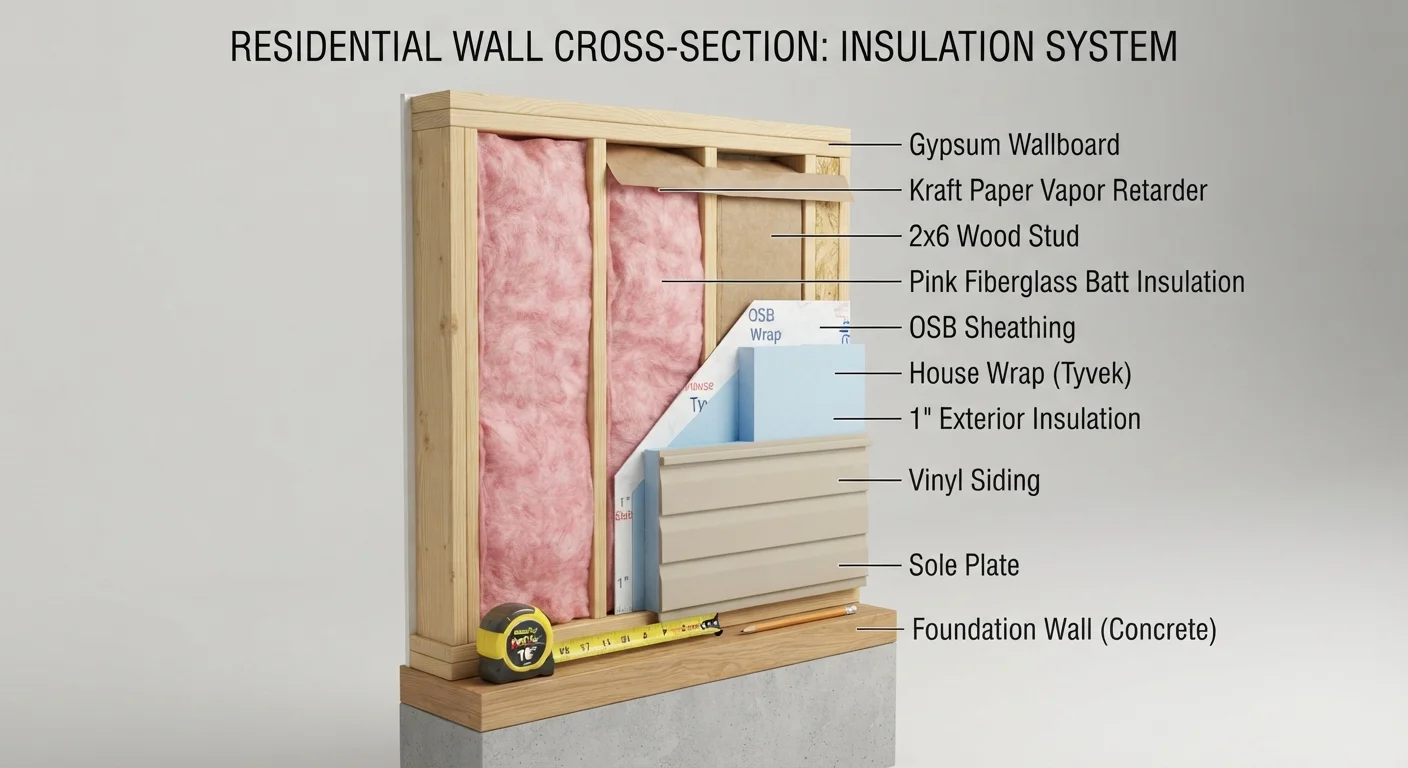
Thermal bridging is also worth knowing. Wood studs conduct heat more readily than insulation, so the actual R-value of a framed wall is lower than the insulation label alone suggests. Continuous insulation on the exterior of a wall reduces this effect.
Common insulation types and their R-values
Different materials deliver different R-values per inch, which affects both cost and how you use them:
- Fiberglass batts: roughly R-2.9 to R-3.8 per inch. Widely available and DIY-friendly for walls and attic floors.
- Blown cellulose: roughly R-3.2 to R-3.8 per inch. Good for topping up existing attic insulation and for irregular spaces.
- Open-cell spray foam: roughly R-3.5 to R-3.7 per inch. Expands to fill gaps; useful where air sealing and insulation need to happen at the same time.
- Closed-cell spray foam: roughly R-6 to R-7 per inch. The highest R-value per inch of common options, but also the highest cost. Usually applied by a professional.
- Rigid foam board: roughly R-3.8 to R-6.5 per inch depending on type. Common for basement walls and exterior continuous insulation.
For most DIY attic projects, blown cellulose or fiberglass batts offer a reasonable balance of cost, availability, and performance. Spray foam in crawl spaces or rim joists often makes sense given those areas' irregular geometry, though closed-cell application typically warrants professional installation.
Frequently Asked Questions

Author
Home on a Budget Editorial Team
Home on a Budget Editorial Team is the collective byline for our editorial team and contributor network. Articles published under this byline or an editorial pen name are researched, written, and reviewed according to our editorial standards for clarity, consistency, and independence before publication.
View all articles