
Thrift Store Finds That Work as Well as New Hardware Store Supplies
In this article
Secondhand shops are overlooked sources for functional home supplies. Discover which items translate reliably from thrift shelf to DIY project.
Key Takeaways
- Many secondhand items from thrift stores perform identically to new hardware store equivalents.
- Hand tools, glass containers, and basic hardware are among the most reliable thrift finds.
- Knowing which categories to trust secondhand can cut supply costs on routine home projects.
- Some categories, including electrical components and safety gear, should always be purchased new.
Why thrift stores deserve a place in your supply chain
Hardware stores carry everything you need, but they charge retail for it. Thrift stores, estate sales, and Habitat for Humanity ReStores carry much of the same functional equipment at a fraction of the price, because donors replace working items rather than discard them. The gap between a donated hand tool and a new one is often cosmetic, not functional.
The strategy is not to buy everything secondhand. It is to know which categories are worth checking before you drive to the hardware store. The items below meet that standard: they are mechanical or inert, their condition is verifiable on the shelf, and they perform the same job whether they are two years old or twenty.
For context on which home projects make financial sense to tackle yourself, see when DIY saves money and when it costs more.
Hand tools
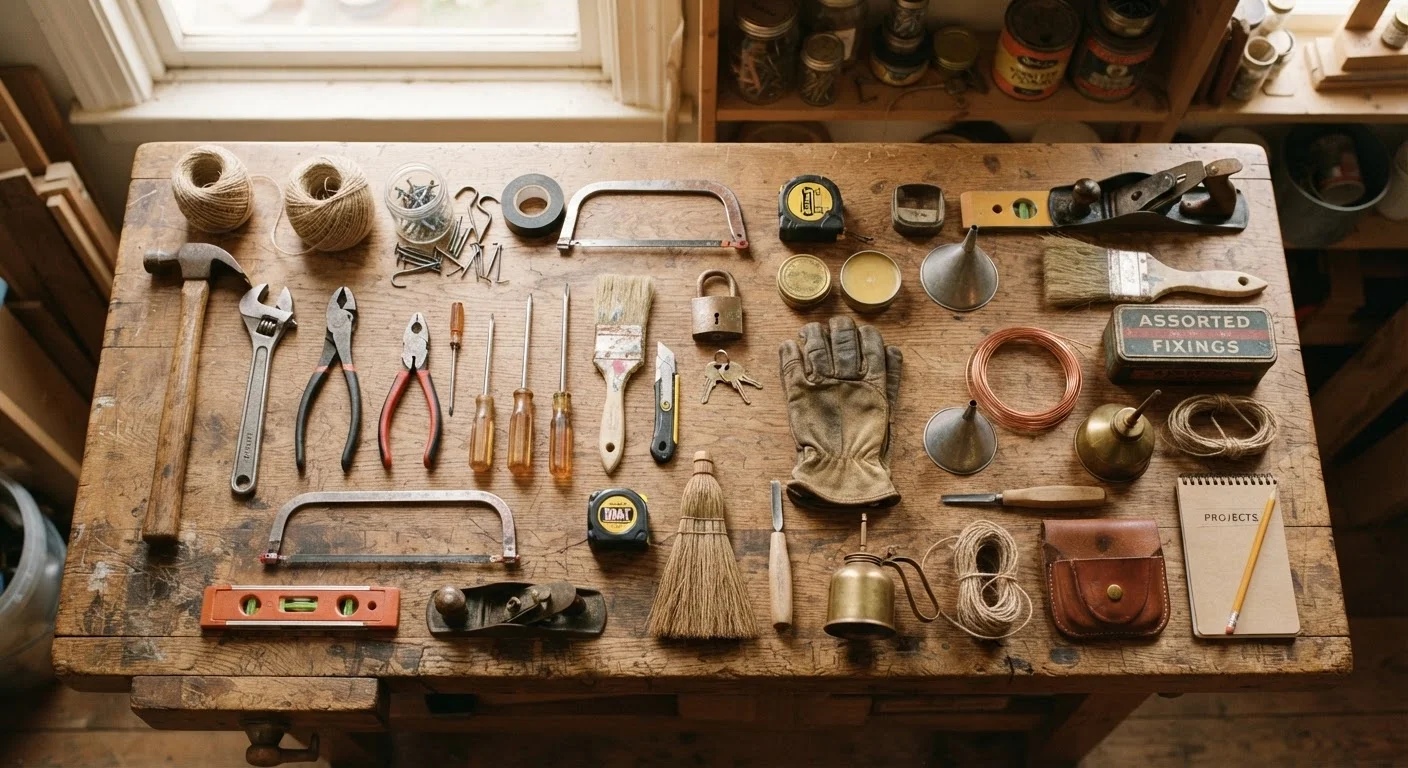
Hammers, chisels, hand saws, and screwdrivers made decades ago were often built from higher-carbon steel than comparable entry-level tools sold today. A thrift store hammer with a solid wooden handle and no cracks in the head will drive nails just as reliably as a new one. Check the head for rust (surface rust wipes off; deep pitting is a reason to pass) and flex wooden handles slightly to confirm they are not splintered internally. Ball-peen hammers, claw hammers, and mallets show up consistently at most thrift locations for a fraction of hardware store prices.
Older hand tools were often made from higher-carbon steel than entry-level tools sold today.
Glass jars and containers
Wide-mouth glass jars are workhorses in a home workshop: they hold nails, screws, sandpaper grit samples, paint brushes soaking in mineral spirits, or seedlings started indoors. Thrift stores sell them by the bag or individually for pennies. Inspect rims for chips that could prevent a lid from sealing, but for workshop organization or garden starting, a chipped rim rarely matters. The same goes for ceramic crocks and glass baking dishes repurposed as mixing vessels for plaster, grout, or cement patch.
Glass jars from thrift stores hold workshop hardware and garden supplies for a fraction of retail cost.
Metal buckets and utility tubs
Galvanized metal buckets and enamel tubs occasionally appear on thrift shelves, and they outlast plastic alternatives in outdoor use. A metal bucket with no holes or significant rust along the seams is perfectly suited for mixing small batches of mortar, hauling compost, or carrying cleaning supplies room to room. Run your hand along the interior seam and tap the bottom: a hollow ring suggests rust is eating through from inside, while a solid sound means the metal is intact.
A galvanized metal bucket with no seam rust will outlast plastic equivalents in outdoor conditions.
Paintbrushes
Natural-bristle and synthetic paintbrushes donated in good condition, where the bristles are fully intact and the ferrule (the metal band connecting bristles to handle) is tight, can be cleaned and used for applying stains, adhesives, or primers. Soak donated brushes in the appropriate solvent (water for latex residue, mineral spirits for oil-based residue), work the bristles against your palm, rinse, and reshape. Avoid brushes where the bristles splay permanently outward or the ferrule is loose: those will leave streaks and shed bristles mid-project.
A thrift-store brush with a tight ferrule and intact bristles cleans up and performs like new.
Measuring and layout tools
Combination squares, levels, tape measures, and T-bevels are mechanical tools with no circuitry to degrade. A metal combination square is accurate as long as the blade slides smoothly and the stock is not bent: test it against a known flat surface or check a 90-degree corner to confirm it reads true. Levels work as long as the bubble vials are uncracked and the body is straight. Lay a thrift-store level against a flat countertop edge and check both ends before buying. These items frequently appear in estate sale donations and are often in working condition.
A combination square or level works at any age as long as the body is straight and undamaged.
Clamps and vises
C-clamps, bar clamps, and pipe clamps have no moving parts that wear out quickly. A thrift-store C-clamp with clean threads and a swivel pad that still pivots is functionally identical to a new one. Apply a little machine oil to the screw threads before use. Spring clamps and small bar clamps appear regularly in tool donation bins. Avoid any clamp where the screw is cross-threaded or the frame shows a crack from overtightening: those will slip under load and are not safe to use on a workpiece you need held securely.
C-clamps with clean threads and intact swivel pads are functionally identical to new hardware store versions.
Ceramic tiles and leftover tile boxes
Donors frequently drop off boxes of leftover tile from completed renovation jobs. If the pattern and dimensions fit your project, this is a reliable source for patch repairs, stepping stones, or small mosaic work. Check that tiles are not cracked through (hairline surface cracks affect appearance but not structural adhesion in non-load applications) and verify the back is clean enough for adhesive to bond. Tiles vary by material, and some older tiles may contain lead glaze: this matters mainly if the tiles will be used as food-contact surfaces, where new tile is the safer choice.
Leftover tile donations are a reliable source for patch repairs and garden stepping stones.
Getting the most from secondhand supplies
Clean and test before any project
Before using a thrift-store tool or supply, clean it thoroughly and confirm it functions correctly on scrap material. A few minutes of testing prevents a ruined project or a mid-task failure. Keep a small container of machine oil and a wire brush in your workshop for reconditioning metal tools quickly.
Thrift shopping for home supplies works best as a first stop on the way to the hardware store, not a replacement for it. Carry a short list of what you need for a current project, check the tool and housewares sections, and buy only what you can inspect fully. Passing on a questionable item is always the right call when the job depends on it.
Pairing smart secondhand sourcing with consistent upkeep reduces what you spend overall. The seasonal maintenance guide covers the tasks that prevent small problems from growing into expensive repairs. Together, these habits stretch a home budget further than either approach does alone. For broader strategies on stretching every dollar, smart shopping habits covers how to avoid overspending across categories.

Author
Home on a Budget Editorial Team
Home on a Budget Editorial Team is the collective byline for our editorial team and contributor network. Articles published under this byline or an editorial pen name are researched, written, and reviewed according to our editorial standards for clarity, consistency, and independence before publication.
View all articles