
Free and Low-Cost Ways Families Can Stay Physically Active
In this article
A practical look at exercise habits that cost little to nothing, from community resources to home routines that work for all ages.
Key Takeaways
- Public parks, trails, and recreation centers offer free or low-cost exercise options for the whole family.
- Consistency matters more than intensity; short daily activity sessions add up over time.
- Community programs through libraries, schools, and nonprofits often provide free fitness classes and sports access.
- Household chores, active commuting, and backyard play count as legitimate physical activity for adults and children.
- Many reputable organizations publish free workout videos and movement guides accessible without a subscription.
Why the cost barrier is smaller than most families think
Many families assume staying physically active requires a gym membership, pricey equipment, or paid fitness apps. The evidence from public health guidance suggests otherwise. The U.S. Department of Health and Human Services recommends that adults get at least 150 minutes of moderate-intensity aerobic activity per week and that children get 60 minutes of movement daily. None of those guidelines specify where or how that movement happens, and most of it can be achieved at no cost.
The ideas below are practical, repeatable, and appropriate for a range of ages and fitness levels. They are general wellness education, not medical advice. If your family has specific health conditions or concerns, consult a qualified healthcare professional before changing your activity habits.
For families building broader wellness habits beyond movement, the starting point guide for budget-friendly healthy living covers food, sleep, and preventive care alongside exercise.
Use public parks and trails
Most U.S. counties maintain public parks with walking trails, open fields, and playground equipment at no charge. These spaces support walking, jogging, cycling, informal sports, and stretching without any fee. The National Recreation and Park Association reports that roughly 90 percent of Americans live within a 10-minute walk of a park, though access varies by neighborhood.
To get the most from these spaces, identify a few routes that vary in length so you can adapt to how much time the family has on a given day. Trail maps are usually available from city or county parks departments, often at no cost.
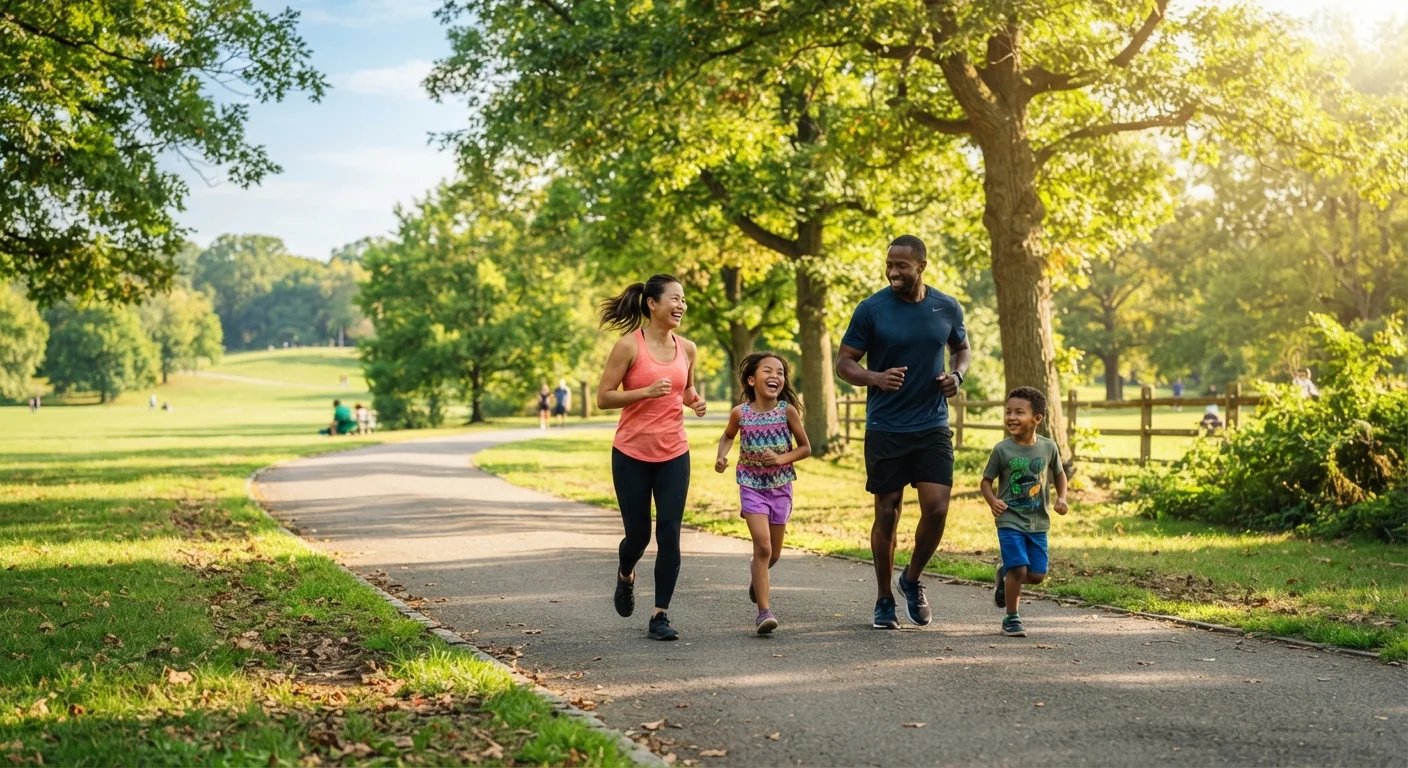
Public parks give families a free, flexible venue for almost any form of movement.
Check community recreation centers for low-cost programs
Municipal recreation centers often charge significantly lower fees than private gyms, and many offer income-based sliding scale pricing. Programs can include youth sports leagues, family swim times, group fitness classes, and open gym hours. Some centers participate in fee-waiver programs for qualifying households.
Call your city or county parks and recreation department directly to ask about reduced-fee options. Many programs go unadvertised online, so a phone call often surfaces options that a web search misses.
Municipal recreation centers frequently offer sliding-scale fees that families with modest budgets can access.
Tap free online movement resources
Several reputable health organizations publish free, evidence-informed exercise videos and guides. The American Heart Association and the Centers for Disease Control and Prevention both maintain free movement resources on their websites. YouTube channels operated by certified fitness professionals offer family-friendly workouts that require no equipment.
When evaluating any free online workout, look for content created or reviewed by credentialed professionals, such as certified personal trainers or physical therapists, and avoid programs that promise rapid or extreme results.
Credentialed fitness content from health organizations is free and requires no subscription.
Count active commuting and daily chores
Walking or cycling to school, errands, or work is physical activity. So is gardening, raking leaves, washing the car by hand, or carrying groceries. Public health researchers have long recognized that incidental movement, activity woven into daily tasks rather than set aside as formal exercise, contributes meaningfully to weekly totals.
Tracking these activities on a simple paper log or a free smartphone health app can help families see how much movement already happens before any structured workout is added. That visibility often increases motivation without adding a dollar of expense.
Daily chores and active commuting count toward weekly physical activity totals.
Look into school and library fitness programs
Public school facilities are sometimes open to community members outside school hours, particularly for walking tracks and gymnasiums. Contact your school district's facilities department to ask. Public libraries increasingly host movement programs, including yoga classes, dance sessions, and walking groups, especially for families and older adults. These programs are typically free with a library card or no card required at all.
Nonprofit organizations such as the YMCA also offer community outreach programs that are free or heavily subsidized, separate from their paid membership tiers.
Libraries and school facilities host free fitness programs that are easy to overlook.
Organize neighborhood or family activity groups
A walking group with neighbors, a weekly pickup basketball game, or a regular family bike ride costs nothing beyond the activity itself. Social accountability is a recognized factor in exercise adherence; people who exercise with others tend to maintain habits longer than those who go it alone, according to behavioral research.
Free apps like Meetup or Facebook Groups can help connect families with existing neighborhood activity groups if organizing from scratch feels like too much effort.
Exercising with others increases the likelihood of sticking with the habit over time.
Making it stick without spending more
The strategies above work best when they become routine rather than one-off events. Anchoring activity to something already on the calendar, a weekend trip to the park, the school pickup walk, or a post-dinner loop around the block, removes the planning friction that derails consistency. Physical activity also connects closely to overall family wellbeing; the relationship between sleep, stress, and health is worth understanding alongside movement habits.
Families who want a more structured approach can find step-by-step guidance in building a family wellness routine without a gym membership.
Start small to build a lasting habit
Research on habit formation consistently shows that smaller, more frequent activity sessions are easier to sustain than infrequent long ones. A 15-minute family walk three times a week is a more realistic starting point than a single 90-minute session on the weekend. Once the shorter sessions feel natural, adding time becomes straightforward.

Author
Healthy Living Cheap Editorial Team
Healthy Living Cheap Editorial Team is the collective byline for our editorial team and contributor network. Articles published under this byline or an editorial pen name are researched, written, and reviewed according to our editorial standards for clarity, consistency, and independence before publication.
View all articles